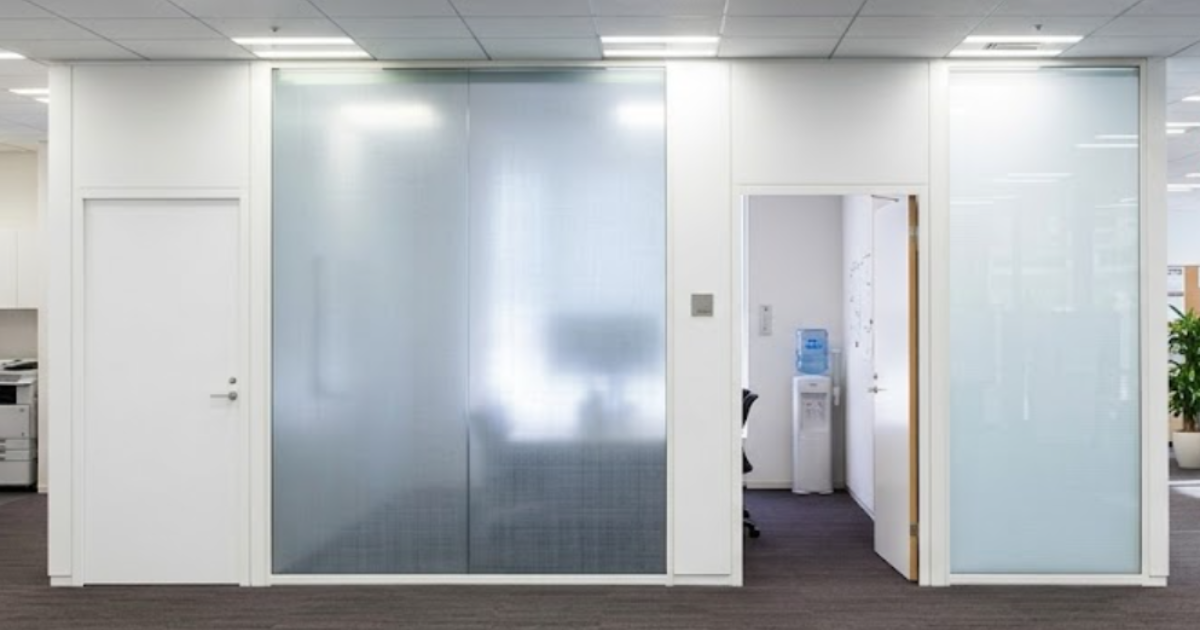
When privacy, branding, or design calls for frosted or patterned glass, two options come up most often: decorative window film and sandblasted glass. Both achieve the same frosted effect, but one can be removed and the other cannot, and that single fact drives every practical consideration that follows.
Sandblasted glass achieves its frosted or etched appearance through a permanent physical process. High-pressure abrasive material roughens the glass surface, creating a translucent finish that scatters light and obscures direct views. The effect is built into the glass itself. Decorative window films achieve a similar visual result through a polyester or vinyl layer applied to the surface of existing glass. Modern decorative films, particularly professional-grade options like 3M FASARA Glass Finishes or 3M Dusted Crystal, are engineered to replicate the look of sandblasted, etched, and specialty glass with a level of consistency and optical quality that is difficult to distinguish from the real material once installed.
How decorative window films and sandblasted glass compare:
| Factor | Decorative Window Films | Sandblasted Glass |
|---|---|---|
| Installation | Applies to existing glass; no removal or replacement needed | Requires custom-fabricated panels and full glass replacement |
| Disruption | Clean, quiet, and feasible in occupied spaces | Construction-level disruption to install |
| Flexibility | Can be removed or updated as tenants, branding, or layouts change | Permanent |
| Maintenance | Smooth surface cleans easily | Textured surface traps dust and fingerprints, professional cleaning may be required |
| Longevity | Performance life of five to twenty years depending on pattern | Lasts as long as the glass itself |
| Design Range | Many pattern families, including gradations that sandblasting cannot replicate without specialized fabrication | Limited to uniform etched effects without additional specialized fabrication |
| Cost | A fraction of the cost of comparable sandblasted glass coverage | Higher cost at every stage: fabrication, shipping, removal, and installation |
Appearance and Privacy
From a normal viewing distance, a well-installed decorative film is functionally indistinguishable from sandblasted glass. The difference is apparent only on close inspection: sandblasted glass has a tactile texture, while decorative film has a smooth surface. For straightforward frosted privacy, both options deliver the same result. The difference is the design range.
3M FASARA Glass Finishes span ten pattern families: Frost/Matte, Gradation, Stripe, Fabric, Natural, Washi, Dot, Border, Geometric, and Reflect. That catalog includes effects that sandblasted glass simply cannot achieve without additional specialized fabrication. Gradation films, for example, transition from opaque to clear across the surface of the glass, providing privacy at eye level while leaving the upper portion transparent. Achieving this effect with sandblasting requires precisely controlled abrasive application that is difficult to replicate consistently across multiple panels.
For projects where a simple, uniform frost is the goal, 3M Dusted and Frosted Crystal Finishes offer a budget-friendly option. 3M Dusted Crystal provides a clean white frosted finish, while 3M Frosted Crystal adds light-reflecting sparkles for a subtly different aesthetic. Both install on interior or exterior glass and deliver privacy and light diffusion at roughly one-third the cost of sandblasted or etched glass.
Installation and Disruption
Installation is where the practical gap is widest.
Sandblasted glass requires removing existing panes and replacing them with custom-fabricated panels ordered to match exact dimensions. Lead times for custom glass fabrication can stretch to weeks or months. In an occupied building, this means noise, dust, restricted access, and scheduling around tenants or operations.
Decorative window film installs directly onto the glass that is already in place using a water-based solution. No glass is removed, no panels are replaced, and no construction debris is generated. The process is clean enough and quiet enough to complete in occupied offices, healthcare facilities, and retail spaces during business hours or after hours, depending on preference. For multi-room or multi-floor projects, installation can be phased without displacing occupants.
Cleaning and Surface Wear
Sandblasted glass is harder to keep clean than it looks. The abrasive process that creates the frosted effect leaves a rough, porous surface that traps dust, fingerprints, and skin oils. In high-traffic environments like lobbies, corridors, and conference rooms, that means more frequent and more attentive cleaning to maintain appearance. Over time, the surface can develop a dingy or uneven look that cannot be corrected without replacing the panel, since the texture is the glass itself.
Decorative window film has a smooth, uniform surface. A soft cloth and a mild, non-ammonia cleaner is all it takes to clean. If a panel is scratched or damaged, it can be replaced individually without affecting adjacent panels or requiring new glass.
In buildings with dozens or hundreds of decorative glass surfaces, that maintenance difference compounds over years.
Lifespan and Flexibility
Sandblasted glass lasts as long as the glass itself. For permanent architectural features where the design will never change, that longevity is an advantage. 3M FASARA Glass Finishes are not permanent, but they are not short-lived either. Performance life runs five to twenty years for indoor, vertical non-perimeter glass depending on the pattern, with a five-year commercial warranty. The practical question is what happens before that lifespan ends.
Tenants leave, brands evolve, and spaces get reconfigured. Decorative film can be removed cleanly and replaced with a new pattern or no film at all, without affecting the glass underneath. That flexibility applies whether the change is a single conference room at the end of a lease or a facility-wide rebrand.
Changing the appearance of sandblasted glass means replacing the glass.
Cost
Custom sandblasted glass carries costs at every stage: fabrication, shipping of heavy panels, removal of existing glazing, and installation by specialized glazing crews. Decorative film has none of those stages. It is cut to size on site, applied to existing glass, and finished in a single visit. The total project cost is typically a fraction of the sandblasted glass equivalent, and a future design change costs new film and labor, not new glass.
Where Sandblasted Glass Still Makes Sense
For permanent architectural features where the design intent is fixed and the tactile texture of true sandblasted glass is part of the aesthetic goal, it remains a strong option. Custom entryway panels, signature design elements in high-end hospitality projects, and monumental glass installations where the physical quality of the glass is part of the experience are all contexts where sandblasted glass can be the right specification.
Working with EPD
Choosing between decorative films and sandblasted glass comes down to whether the project needs permanence or flexibility. For most commercial environments, film is the practical answer, but the right film depends on glass type, privacy requirements, pattern selection, and installation orientation.
Energy Products Distribution (EPD) has been a 3M Master Distributor since 1985 and carries the full 3M FASARA Glass Finishes catalog along with 3M Dusted and Frosted Crystal Finishes. EPD’s product specialists help dealers and building professionals match the right film to each application. EPD’s installer network connects building owners and facility managers with experienced decorative film installers.
Energy Products Distribution is a Master Distributor of 3M Window Films, 3M Paint Protection Films, 3M Wrap Film Series 2080, 3M Protection Wrap Films, 3M Architectural Finishes, 3M Ceramic Coatings, and Windshield Skin. We sell our products to professional installers throughout the US who provide turnkey installations (labor and material) to end-users in the automotive, commercial, government, and residential markets. Contact us to learn more about the benefits of these products.