
Security window film is one of the most practical upgrades you can make to improve the safety of your property. It strengthens your windows, reduces the risk of injury from shattered glass, and helps slow down forced entry.
But like any security solution, it has limits.
Understanding what security window film can and cannot do will help you make a more informed decision and ensure it is used effectively as part of a broader security strategy.
Key Limitations and Performance Factors of Security Window Film
- Film helps to hold glass together after breakage; it does not prevent glass from breaking
- Film helps to delay forced entry; it does not stop a determined attacker indefinitely
- Security window film is not bulletproof or bullet-resistant
- Performance varies based on glass type, film construction, and whether an attachment system is used
- Thicker film is not automatically better; material composition matters as much as thickness
- Tempered glass requires special consideration before film can be specified
- Film and attachment system represent one layer of a security approach, not a complete solution on its own
What Security Window Film Actually Does
At its core, security window film is designed to hold glass together after it breaks.
When untreated glass shatters, it falls away quickly, leaving an immediate opening. Security film can change that outcome as broken glass stays bonded to the film, creating a barrier that is much harder to push through.
This creates two key benefits:
- Delayed forced entry
- Reduced injury from flying or falling glass
For many properties, especially retail storefronts or ground-level offices, this added delay is often enough to discourage opportunistic break-ins.
Security Film Does Not Make Glass Unbreakable
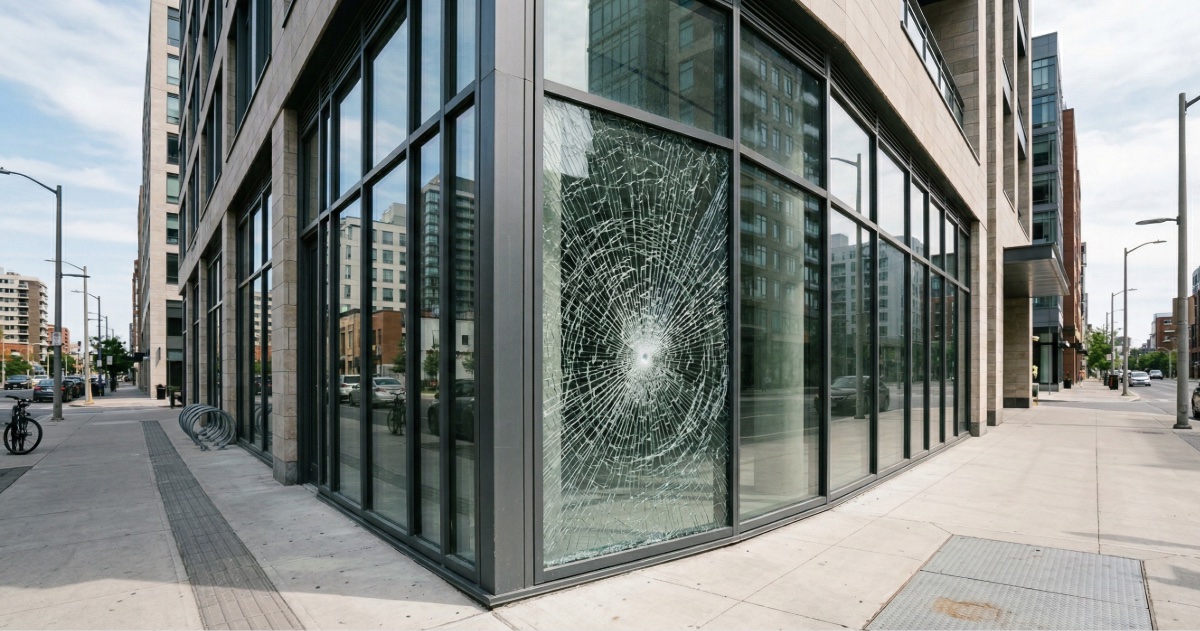
Glass with security film will still break under impact. The film does not strengthen the glass or make it impact-resistant. A strong strike will crack and shatter the pane just as it would without film. What changes is what happens after the break.
When untreated glass breaks, it falls away almost immediately, leaving an instant opening. With security film applied, broken glass remains bonded together and stays in place. Instead of an immediate entry point, the attacker now faces a flexible, reinforced barrier that resists tearing and requires sustained effort to breach. As a result, the time and force needed to create an opening large enough to enter increase significantly.
This distinction is often misunderstood. Building owners sometimes focus on whether the glass breaks during a demonstration, rather than how long it takes to get through the opening afterward. These are two different measures of performance, and only the latter reflects how security film actually works.
Why Security Film Attachment Systems Matter
One of the most underappreciated factors in real-world security film performance is whether an attachment system is used alongside the film.
Security window film, installed without anything anchoring it to the window frame, holds the glass together but does not prevent the entire filmed pane from being pushed inward in one piece. A strong kick or sustained impact can pop the filmed glass out of the frame as a unit, bypassing the delay the film was supposed to provide.
An attachment system, such as 3M’s Impact Protection Adhesive, closes this gap by bonding the film to the glass to the frame, requiring an attacker to defeat both the glass and the structural connection. The difference in performance is significant.
Read more about how security window film attachment systems improve forced entry resistance.
Security Film Thickness Is Not the Whole Story
Security window film is often discussed in terms of thickness, and within traditional polyester (PET) film categories, thickness can be a useful point of comparison. A thicker film from the same product line will generally provide more resistance than a thinner one.
However, thickness alone does not reliably predict real-world performance across different types of film.
Modern security films are made from different materials that behave very differently under impact. Traditional polyester films tend to be more rigid, while newer technologies, such as urethane-based films like 3M Scotchshield Safety & Security Window Film System S2400, are engineered to be far more flexible. Instead of resisting impact and tearing at a certain threshold, urethane films are designed to stretch and absorb energy, helping hold the glass together under sustained force.
This distinction matters. A film with greater thickness but lower flexibility may fail sooner under stress, while a thinner or similarly thick film with higher elongation and tear resistance can continue performing longer in a forced entry scenario.
When evaluating options, comparing films by thickness alone can lead to the wrong conclusion. The more relevant questions are how the film is constructed, how it manages impact energy, and what type of threat it is designed to address. Those answers provide a far more accurate picture than numbers on a spec sheet.
Bullet Resistance Requires a Different Solution
Security window film does not provide bullet resistance.
Film is designed to hold glass together under impact and to slow down forced entry. Ballistic glazing is an entirely different category of product with different construction, thickness, and testing standards. No window film product on the market provides meaningful resistance to gunfire. If bullet resistance is a requirement for your facility, that conversation needs to center on ballistic-rated glazing systems, not window film.
The confusion sometimes arises because security film and ballistic glass both relate to physical security, and because film is sometimes applied to ballistic glazing to contain spall. The applications do not overlap. If someone is telling you that security window film will stop bullets or slow them meaningfully, that is not accurate.
Glass Type Affects What Security Film Can Do
Not all glass is the same, and the type of glass in your building affects both whether security film can be installed and how it will perform.
Tempered glass presents a specific challenge. Tempered glass is engineered to shatter into small, relatively harmless fragments when it breaks, a safety feature that conflicts with how security film works. Film applied to tempered glass can still provide some benefit, but the interaction between tempered glass behavior and film performance is different from what you get with annealed or laminated glass.
Confirm your glass type before making any decisions about security film. An installer can identify your glass type during a site assessment, and that information should help you choose the best film and how performance expectations are set.
Security Window Film Limitations by Threat Level
Security window film is well-suited to a defined range of threat scenarios:
- Smash-and-grab retail theft
- Opportunistic forced entry
- Minor blast events
- Glass breakage from accidents or severe weather
For these scenarios, it can be a cost-effective and proven intervention. There are threat levels where film is not the right answer on its own, or is not sufficient without additional layers of security. A highly motivated attacker with tools and time will eventually defeat any film installation. Active shooter scenarios require a broader set of security measures; film can contribute to slowing entry through glass, but it is not a substitute for access control, trained personnel, and architectural hardening. The value of film in a layered security plan depends on what the other layers are and what threat level the overall system is designed to address.
Matching the right security intervention to the right threat is a judgment call that benefits from a professional assessment. A building with heavy retail foot traffic and a history of smash-and-grab incidents has different needs than a financial institution concerned about sustained forced entry.
Installation Quality Is Not a Minor Variable
Security film performs as specified only when it is installed correctly. Film applied with poor adhesion, bubbles, or edge lifting provides less resistance than the same product installed cleanly. Edges that are not properly sealed can become the weak point in a forced entry scenario, where an attacker finds the edge rather than working through the center of the pane.
Qualified installation is what makes the difference. A professional installer familiar with security applications will know how to apply film in a variety of situations.
Film Works Best as Part of a Plan
The right question is not whether security window film works. It does. The question is whether it addresses the specific vulnerabilities and threat assessments in your building and fits alongside the other measures already in place.
Film addresses one vulnerability well: glass as a point of entry. A building where glass is the primary security gap and the threat is opportunistic property crime is a strong candidate. A building with no alarm system, no response capability, and serious threat concerns is one where film alone will not close the gap, even when it performs exactly as designed. Access control, lighting, alarm response, and trained personnel are not redundant with film; they address different parts of the same problem.
Secure Your Building With Security Window Film
If you are evaluating security window film for your property, a qualified installer can assess your glass type, review your threat concerns, and present multiple product options, including whether an attachment system belongs in the specification. Energy Products Distribution (EPD) works with professional installers throughout the United States. Use EPD’s Find an Installer tool to connect with a dealer near you.

Energy Products Distribution is a Master Distributor of 3M Window Films, 3M Paint Protection Films, 3M Wrap Film Series 2080, 3M Protection Wrap Films, 3M Architectural Finishes, 3M Ceramic Coatings, and Windshield Skin. We sell our products to professional installers throughout the US who provide turnkey installations (labor and material) to end-users in the automotive, commercial, government, and residential markets. Contact us to learn more about the benefits of these products.