
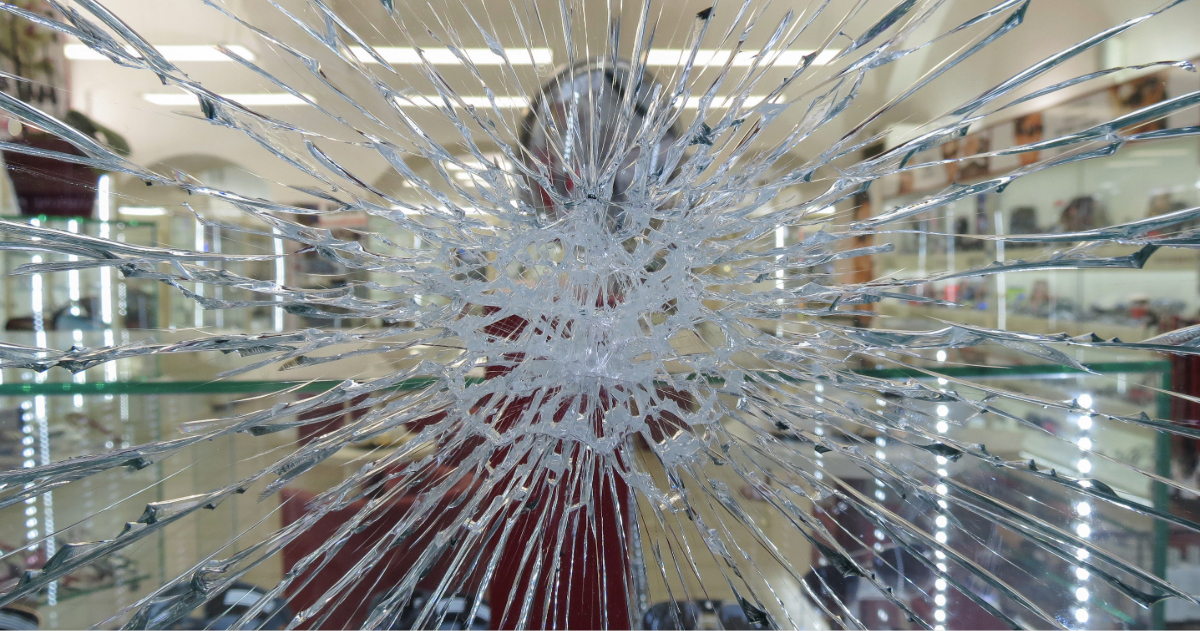
“Ballistic-resistant films” read like a defined product with a rating behind it, but they are not. The term appears in installer marketing, state school-safety legislation, and government procurement specs, but there is no third party accredited test standard that applies to the bullet resistance of window film by itself. When a client opens a conversation with “we need ballistic film,” the request names a product category that simply does not exist. The dealer’s job is to find out what the client is actually worried about before any specification begins.
Quick Answer
- “Ballistic-resistant film,” “bullet-proof film,” and “bullet-resistant film” are not actual product categories. No film by itself carries a ballistic rating.
- Security window films are retrofit products that help hold broken glass together and delay forced entry. They will not stop bullets.
- Ballistic glazing is a full glazing replacement, tested to UL 752, built to stop rounds. It is an entirely different product from window film.
- Many clients who say “ballistic film” are using the term incorrectly or loosely. What they may mean is that they want their glass to resist a physical attack, not stop bullets.
Where the Term “Ballistic Film” Comes From
The phrase “ballistic film” does not originate with 3M or any major window film manufacturer. It comes from general misunderstanding, third-party installer websites, reseller listings, and legislative text written by policymakers who do not always distinguish between film and glazing. Because security film and ballistic glazing both address physical threats to glass, both show up in the same school, government, and high-security commercial conversations, and the language has blurred together over years of loose marketing.
That blur has a cost. A term with no rating behind it gets written into a spec as if it were a performance requirement, and the dealer is left interpreting what the client meant rather than what the document says. Energy Products Distribution (EPD), a 3M Master Distributor, fields these questions regularly, and the pattern is consistent: “ballistic” is usually shorthand for wanting the glass to hold up to a physical attack after being shot.
Two Different Products for Two Different Threats
Security window films are a retrofit. They bond to existing glass and change how that glass fails. Untreated glass shatters and falls away on impact, leaving an opening. Filmed glass combined with an impact protection attachment system breaks but stays bonded to the film, so the pane holds together and a breach takes additional effort. The film does not stop the glass from breaking. It keeps the broken glass in place, which is what helps to delay forced entry and retain fragments during a blast or storm event.
Ballistic glazing is a different product entirely. It is a multi-layered glass and polycarbonate assembly that replaces the existing glazing, tested to UL 752, which assigns levels by the caliber and number of rounds the assembly stops. It is engineered to defeat a projectile.
No security window film provides resistance to gunfire. Film can delay an intruder and retain fragments. It cannot stop a bullet.
What Security Films Do Well
Within its actual purpose, security films earn their place across commercial work. They deter forced entry at storefronts and entries, retain fragments during blast or windstorm events, meet safety glazing requirements, and help to slow down an active threat at a school entrance. The 3M safety and security film lineup covers this range across several construction types.
For school hardening and break-in deterrence, the progression runs from foundational shatter protection up to the strongest film 3M makes. 3M Safety S140 is a 14-mil, three-ply polyester film with a 350 lbs/in break strength, built for break-and-entry deterrence. 3M ULTRA S800 is an 8-mil microcomposite film with a 253 lbs/in break strength. With the 3M Impact Protection Attachment, it carries ASTM E1886/E1996 impact certification at Missile Level C. 3M Scotchshield Safety & Security Window Film System S2400 is the highest-performing film in the lineup, a 24-mil urethane film that passes UL 972 on annealed and tempered glass.
These ratings belong to the film bonded to the frame by the 3M Impact Protection Attachment, not to film on its own. The wet-glaze method within that system is the 3M Impact Protection Adhesive, a structural silicone sealant caulk that anchors the filmed glass to the frame so the pane is harder to push out under sustained force. One thing the ratings do not measure is bullet resistance, and thickness does not change that: a thicker film is not a step toward stopping gunfire. What does drive a film’s forced-entry performance is material composition rather than thickness, which the common myths about security window film cover for client conversations.
Handling a Request for Ballistic Film
When a client asks for “ballistic-resistant film,” it is important to understand the concern behind the request. Most people using ballistic language are not actually looking for bullet-resistant glazing. They’re trying to address forced entry, school safety, smash-and-grab crime, or another active-threat scenario.
In many of those cases, a 3M security window film paired with the 3M Impact Protection Attachment is the appropriate solution. The terminology may be inaccurate, but the underlying concern is legitimate and can often be addressed with a properly designed security film system.
When the threat assessment is about gunfire rather than gunfire aimed at glazing to breach an otherwise locked building, a different product is needed. Bullet resistance requires glazing systems that have been tested and rated to various standards, including UL 752. Window film can still serve a supporting function, such as acting as a spall liner on ballistic glass or protecting secondary glazing that does not require a ballistic rating, but it is not the primary protective barrier.
Being able to guide a client from a broadly worded request to the correct performance standard demonstrates real specification expertise. It also helps set realistic expectations by clearly defining where security film is effective and where a rated ballistic glazing system becomes necessary.
However, it is not a Dealer’s responsibility nor place to make product recommendations. An end-user should commission the services of a security consultant to determine threat levels and ultimately study available product testing data to make their own determination.
EPD Dealer Support
Energy Products Distribution works with dealers across the country on security film specifications for schools, government buildings, retail storefronts, and commercial facilities. Dealers, facility managers, school administrators, and others in need of security film solutions can schedule a consultation with Andrew DeCastecker, Building Window Films Portfolio Manager to discuss film selection and attachment configuration on a specific project.

Energy Products Distribution is a Master Distributor of 3M Window Films, 3M Paint Protection Films, 3M Wrap Film Series 2080, 3M Protection Wrap Films, 3M Architectural Finishes, 3M Ceramic Coatings, and Windshield Skin. We sell our products to professional installers throughout the US who provide turnkey installations (labor and material) to end-users in the automotive, commercial, government, and residential markets. Contact us to learn more about the benefits of these products.